LES PETITS VÉLOS
INEX, France, 2019
Here is another self-published, quite recent French game. As many such games, there is the name of a publisher, which even had a website at some point. Unfortunately, the website did not last long (the domain is for sale now, and the website itself was last captured by the Internet Archive in August 2018). So the only information I have found about the release of this game is that it was crowdfunded (at the French Ulule website) and that the campaign ended successfully on March 6th, 2019, and that there has been a second campaign which has ended in April, 2021. I must admit that I had completely missed that one (both campaigns), but fortunately my friend François did not ;-)
As with many crowdfunded games, there were different "rewards", which means different versions of the game. I will describe mine, of course, but be aware that you may have a slightly different variation.
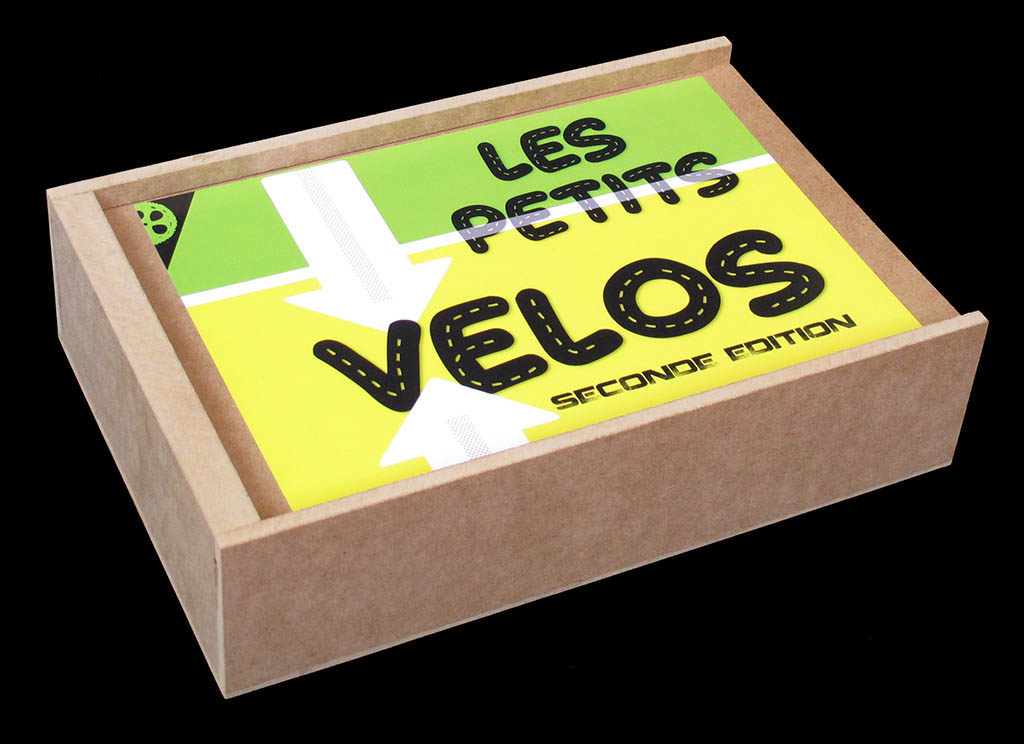
The first thing you notice about this game is that it is quite heavy. As you can see in the picture above, it comes in an MFD fibreboard box (measuring 35 x 23 x 9 cm) and its weight exceeds 2.5 Kg. Probably not intended for overseas shipping.
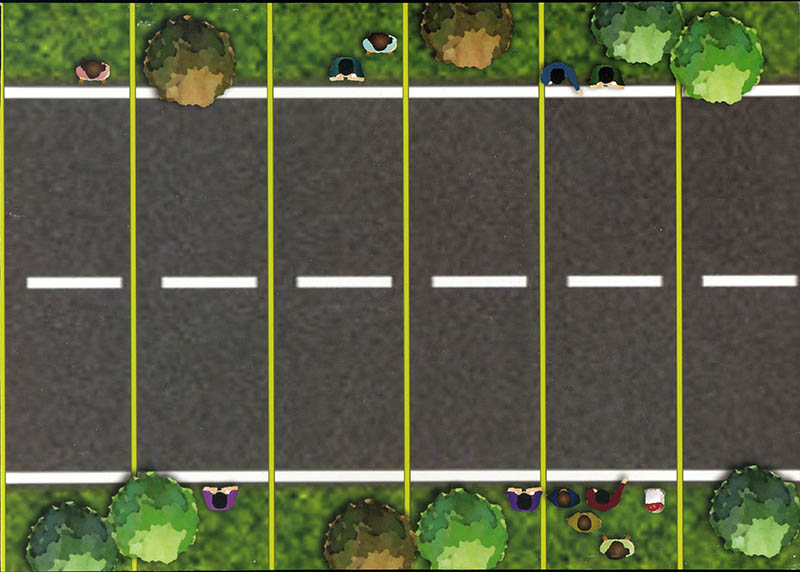
Inside the box we have four identical A4-sized boards with six fields each, with which we can assemble a 120-cm-long track. The game presentation says that a game lasts 30 minutes if we play on one of the boards, or 120 minutes for a complete stage on the 4 boards. It also warns us that a Tour de France should be no fewer than 12 stages long.
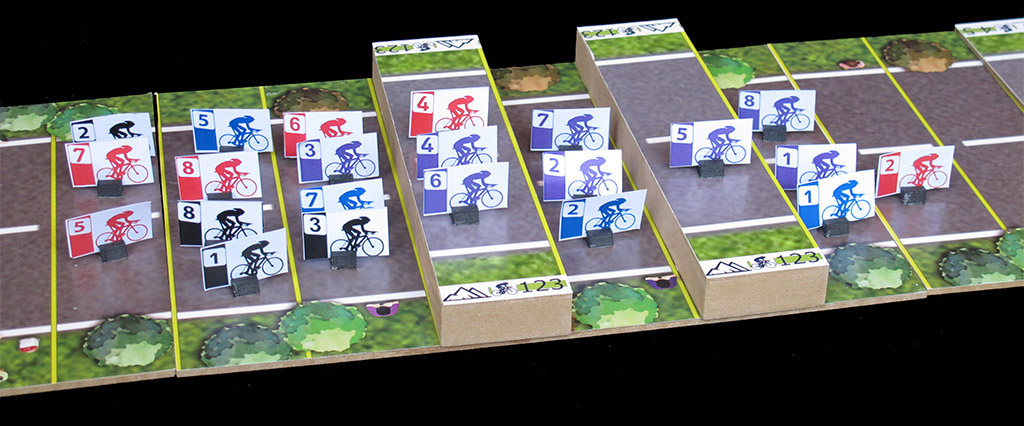
Then we have the modules you can see in the picture above, which come in two thicknesses and which are placed on one field. The thicker module (marked "123") represents a climb, while the thinner module (marked "45"; see picture below) represents a sprint. I insist, this is in MY version of the game: I have one of the most complete versions (thanks, François) and I have five of each.
The rules are not too clear about how the modules should be placed. As is usual with amateurishly written rules, as is the case here, the authors believe that everything is clear and everybody will understand, but it is often not the case. Fortunately there are some pictures on the crowdfunding page that allowed me to see how I was supposed to place these modules. (There are some videos too, but I hate to have to watch videos simply because game makers are unable to write rules. I am sorry, but I had to say it.)
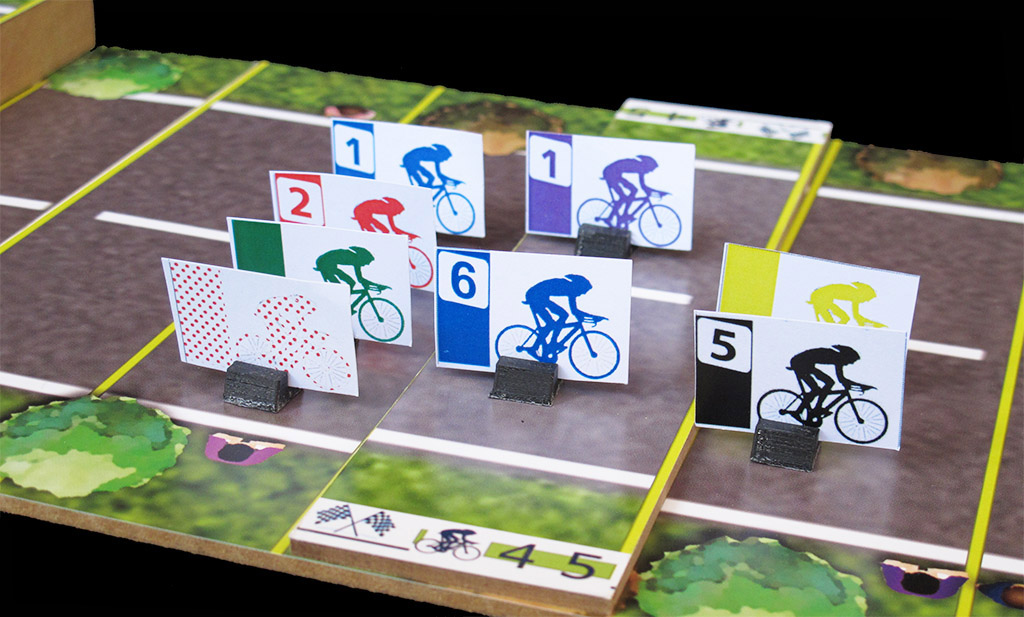
The game is played by three or four players (recommended age: 12+) who manage a team of 8 riders each. So we may have up to 32 cyclists on the road. There are actually 35 included in the game since we have the usual three maillot riders.
Riders with numbers 1, 2 and 3 skip the mountain fields. Riders with numbers 4 and 5 skip the sprint fields. Riders with numbers 6 to 8 do not skip any field. Riders with number 1 are also favoured in time trials and are, therefore, team leaders. As you can easily deduce, riders 2 and 3 are climbers, 4 and 5 are sprinters, and the remaining three are domestiques.
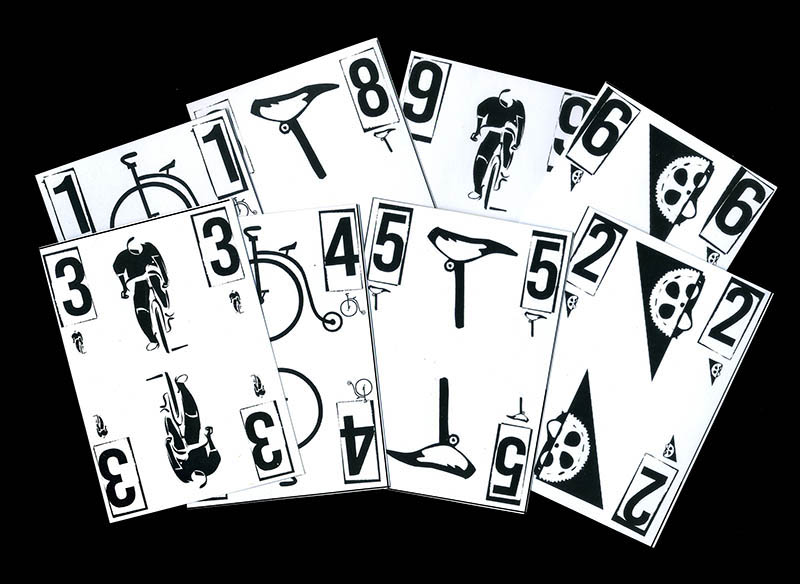
What makes this game unusual among cycling games is its mechanics. My copy of the game is supplied with big (95 x 68 mm), quite amateurish) cards, but the game can be played with a regular deck. In fact, the rules refer all the time to a regular deck.
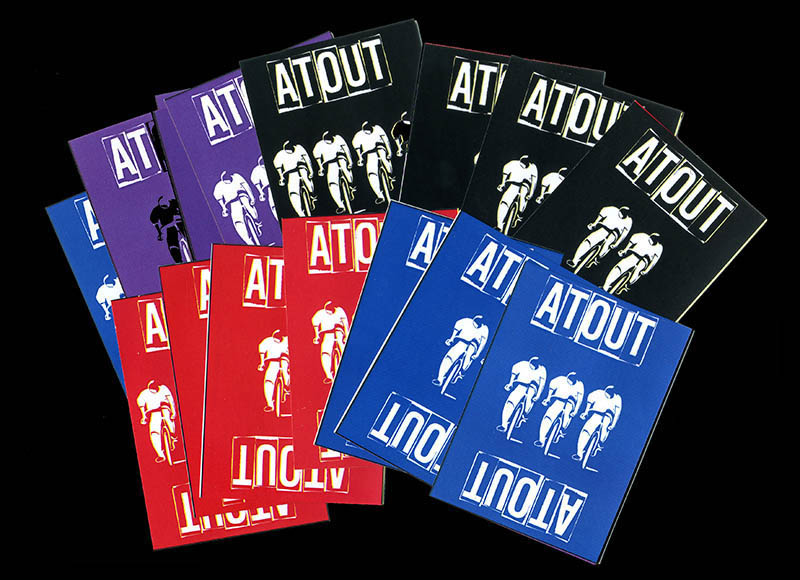
Anyway, whether you have a regular or a custom deck, you happen to play a standard trick-taking card game. In this case, you have to follow suit or else break it with a trump ("atout") card (10, V, D, or R -remember we have a French deck; it is 10, J, Q, and K for the rest of you-). The basic rule is that the winner of the hand advances one square his riders that match a number card he has collected (9 and trumps do not move riders).
While I admit that it is an interesting addition to cycling games' movement mechanics, I am not particularly sure it works as a cycling simulation. I admit I haven't played the game, so it is just a guess, and I may change my mind if I ever have a chance to play this game.
Of course, there are other rules in this game, but they are not unusual and therefore not worth mentioning here, except for a couple of details, both in the second edition of the game:
- Now we have some "increvable" (puncture-proof) pieces, which I am not sure what use they have but which kind of remind me of 1000 Bornes.
- The second edition also mentions a mobile app to throw dice to make the game more dynamic. So, in the end, might we end up with a board game that depends on an app and which loses its most interesting, or at least unusual, feature? Is that what you mean, guys?
I will NOT download the app (I am stubbornly against these things), and I will try to keep an eye on the game development to see what happens, but I must admit I am not too optimistic.

You cannot see it in the picture I took of the box, but the INEX FRANCE logo is actually there. However, since their website is down, the only thing I can tell you about INEX is that they seem to be two guys from Mandelieu-La-Napoule (fellow Mediterraneans) and that at some time they did another (non-cycling-related) game called Cube.
Thanks again François for this game.
Description written in August 2021.
 |
 |
 |
 |
 |
|
CULTURE IDEAS |
TOTUM REVOLUTUM THUMBNAILS |
NAMES ALPHABETICAL |
CATEGORIES LISTS |
WHAT'S NEW BLOG |