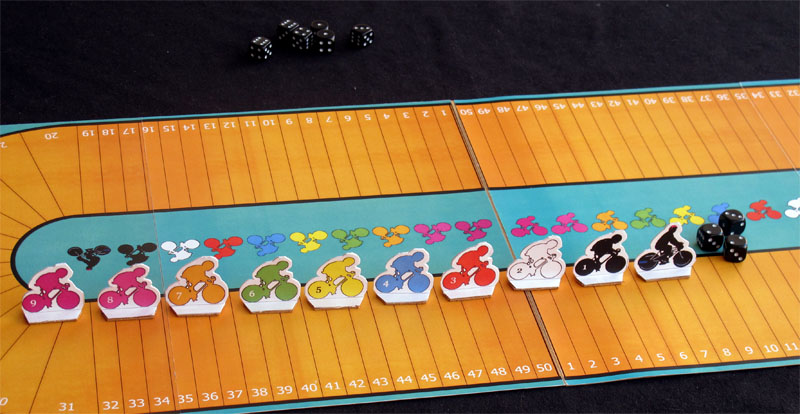
KEIRIN
Anki Toner, 2006/2012
click here to downnload the game (PDF, 5 pages, 1.1 Mb)
This game can be considered is a one-player non-strategy game. You just throw the dice and watch the race. It can also be considered just the set of rules for the final sprint in a bigger game. Why not? You can use it if you want. But what it really is, is a betting game, like real Keirin, at least in Japan, is a betting event. Below are some probabilities. You might argue that the chances are not even between the riders. I admit they are not, and I advise you NOT to bet a fortune on this game (or on any other).
I created this game a few years ago. It was supposed to be a prin't and play game, but there was not much to print. In 2012 I have decided to make a real prin'n'play game out of it.
The main differences are:
a) There are 9 racers now, like real in keirin races, instead of six. However, for a shorter game, you can drop some riders (the ones with the highest numbers). Playing with 6, 7 or 8 riders is ok.
b) You do not need a lot of different coloured dice. You just need as many dice as racers, that is, nine dice.
c) The motorbike now takes part in the game, even if it's just in the first turn. It is not there "just for the ambiance" anymore. The rule foir the first throw of rider 1 has also changed.
The rest of the rules have not changed.
KEIRINIntroduction:
Unlike the conventional track sprint discipline where riders seek to "draft" or "slipstream" each other, in the first few laps of the Keirin, cyclists are paced by a motorised vehicle called a derny, who leaves the track a few laps before the end, at a speed of about 50 km/h. The first cyclist to finish the high-speed (sometimes at 70 km/h) race is the winner.
This game starts at the precise moment when the derny leaves the track.
Material:
Nine cyclists numbered 1 to 9, a derny , 9 dice (which you will have to provide), a 100-field-long track.
Preparation:
Place the derny in square 0 of one of the halves of the track. Throw THREE dice and advance the derny according to the number thrown (add the numbers on the three dice).
Place the riders behind the derny forming a single line.
Since the fields are short and the riders occupy three fiels, this means that you place a rider every three fields. For instance, if you have thrown 12 for the derny, the derny is placed on square 12, rider 1 is placed on square 9, rider 2 is played on square 6, rider 3 on square 3, rider 4 on square 0 (that is square 50 of the other half of the track), rider 5 in square 47, etc, until rider 9 is placed on square 35.
Now the derny pulls out of the race and on its slipstream, rider one advances THREE fields. (He occupies the place where the derny was. The derny is taken out of the board. The other riders remain where they were).
The race starts here.
Movement of the riders:
For the rest of the race, each rider throws as many dice as his number. Rider 1 throws one die, rider 2 throws two dice, etc...
For all purposes, 1s and 2s on the dice are assimilated to 3s (the dice can be regarded as D6 numbered 333456)
Only the highest number on each throw is taken into account. If the throw has more than one 6, each additional six counts as an extra pip.
Example:
Rider 1 throws 2. He advances 3 squares.
Rider 2 throws 1-5- He advances 5 squares.
Rider 3 throws 3-6-6. He advances 7 squares.
Rider 4 throws 1-1-2-3. He advances 3 squares.
Rider 5 throws 4-5-5-5-6. He advances 6 squares.
Rider 6 throws 1-1-2-6-6-6. He advances 8 squares.
etc..The highest possible throw, of course, is 9 sixes by rider 9. He would advance 14 squares.
Winner of the race:
THe race ends at the end of the turn when the first rider(s) cross the line. (The turn is completed). The winner of the race is the rider who goes further past the finishing line during that turn.
In the case of a tie, an extra turn is thrown only between the tied riders for a "photo-finish".
If you bet on the first three riders, and only one or two riders have crossed the line in the same turn, take those riders out of the board and play another turn for the next positions.
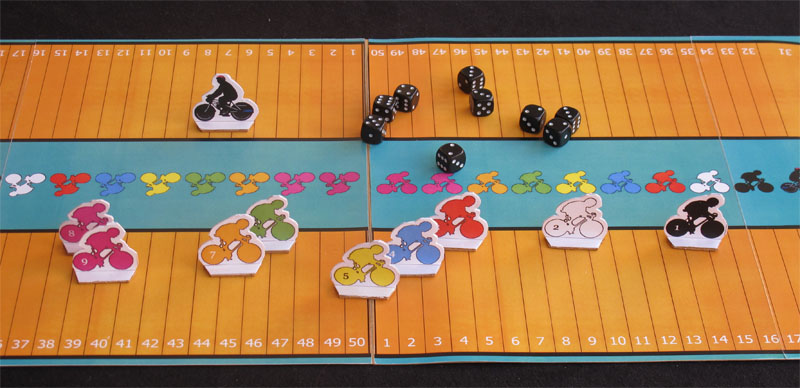
After the first throw, rider 1 (R1) slipstreams from the derny and has a small advantage.
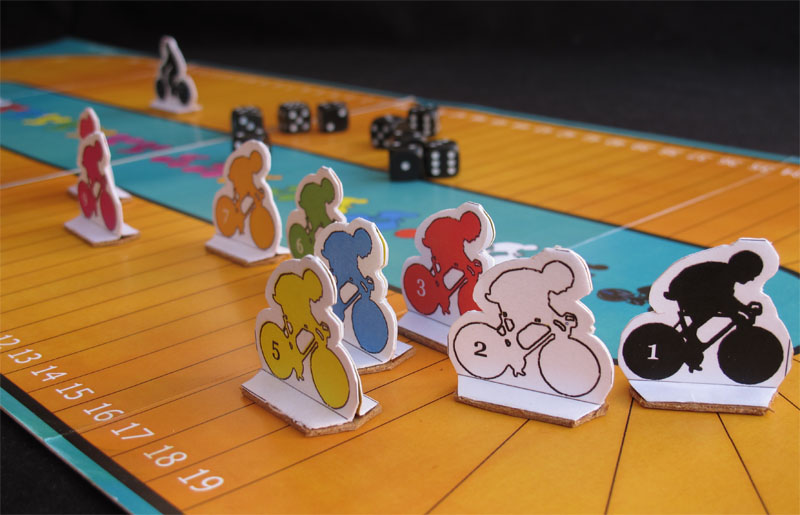
Entering the curve: R1 still in the lead. R5 has alreadyovertaken a R3 and R4.
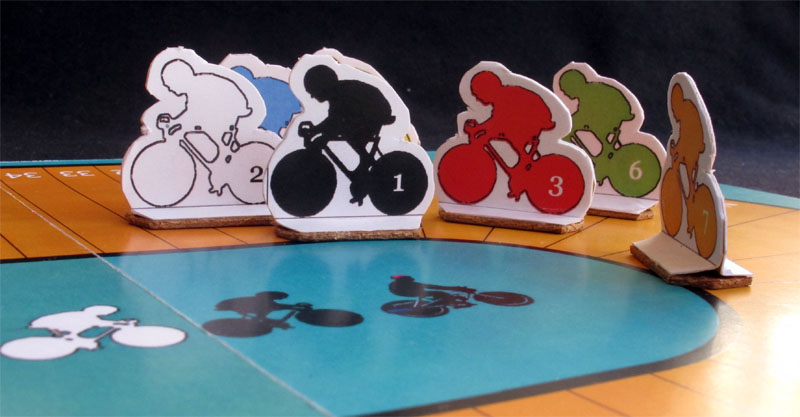
A couple of throws later, R2 is in the lead, followed by R4 (blue), still R1 and R5 (hidden).
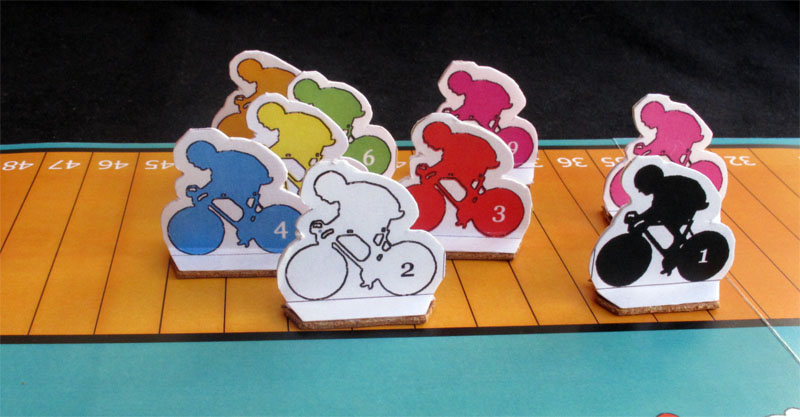
Final sprint: R4 and R7 (orange) in the lead, but very close for R2, R5 and R6. R9 is coming at great speed.
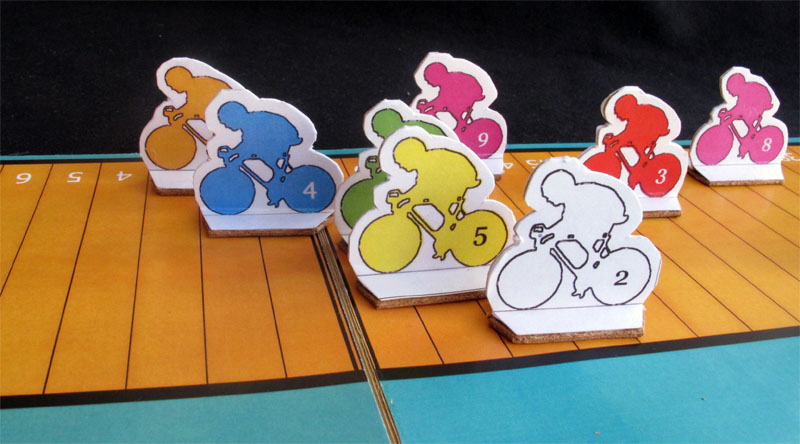
R5 wins by a wheel!
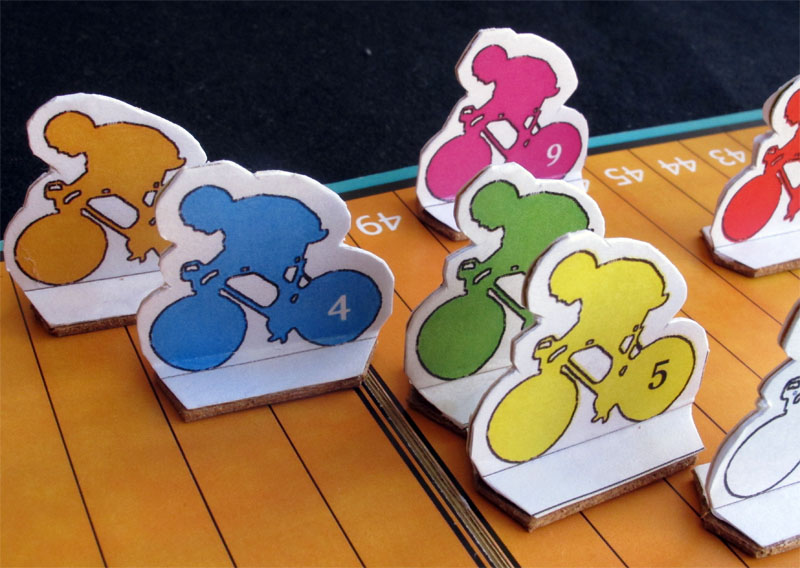
The sprint under a different angle
Click here to see a complete example race. (This example was made for the 2006 version of the game. There are just six riders, and no derny)
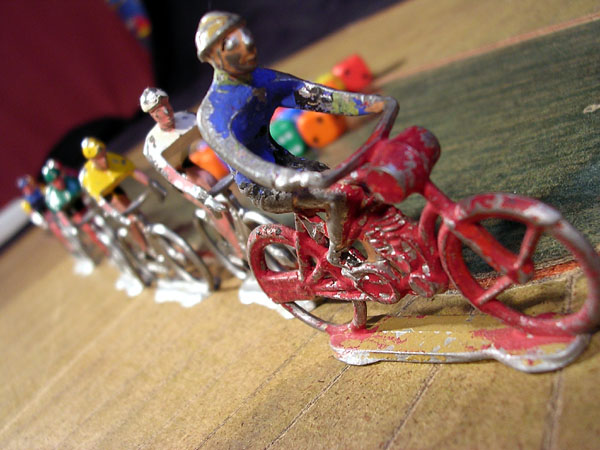
This is what
the game used to look like.
Click here
to see more pictures and read how I made it.
Probabilities (In case you like them)
R1 advances an average of 4.000 squares per turn
(3+3+3+4+5+6) / 6 = 4R2 advances an average of 4.638 squares per turn
(9*3 + 7*4 + +9*5 + 10*6 + 1*7) / 36 =4.638R3 advances an average of 5.079 squares per turn
(27*3 + 37*4 + 61*5 + 75*6 + 15*7 +1*8) / 216 = 5.079R4 advances an average of 5.407 squares per turn
(81*3 + 175*4 * 369*5 + 500*6 + 150*7 + 20*8 + 1*9) / 1296 = 5.407R5 advances an average of 5.670 squares per turn
(243*3 + 781*4 + 2101*5 + 3125*6 + 1250*7 + 250*8 - 25*9 + 1*10) / 7776 = 5.670R6 advances an average of 5.897 squares per turn
(729*3 + 3367*4 + 11529*5 + 18750*6 + 9375*7 + 2500*8 + 375*9 + 30*10 + 1*11) / 46656 = 5.897If we call "0" the square where R1 is behind the derny (before he gets the three extra fields beacaus of the slipstream) we have the following table (square where each rider finds himself at any given turn, rounded at the first decimal, which does not mean anything)
In bold pink, the theoretical leader after n turns.
Turn
R1 (4.000)
R2 (4.638)
R3 (5.079)
R4 (5.407)
R5 (5.670)
R6 (5.897)
0
0
-3
-6
-9
-12
-15
1
7
1.6
-0.9
2
11
6.3
4.2
3
15
10.9
9.2
4
19
15.6
14.3
5
23
20.2
19.4
18.0
16.2
14.5
6
27
24.8
24.5
23.4
22.0
20.4
7
31
28.5
29.6
28.8
27.7
26.3
8
35
34.1
34.6
34.3
33.6
32.2
9
39
38.7
39.7
39.7
39.1
38.1
10
43
43.4
44.8
45.1
44.7
44.0
11
47
48.0
49.9
50.5
50.4
49.9
12
51
52.7
54.9
55.9
56.0
55.8
13
55
57.5
60.0
60.3
61.7
61.7
14
59
62.0
65.1
65.7
67.4
67.6
15
63
66.6
70.2
72.1
73.0
73.5
18
75
80.5
85.4
88.3
90.1
91.1
20
83
89.8
95.6
99.1
101.4
102.9
As you can see, in an average race, R1 should lead during the eight first turns, in which he advances 35 squares, and then he is overtaken by the other riders. If the derny has thrown three sixes, R1, starting the race at 35 squares from the finish line, has good chances to win the race. On the other hand, if the derny throws three ones and leaves R1 at 50 squares from the finish, the race shouldl be close between riders 2 to 6, while R1 should be behind.
Of course, this is just theory, since half of the riders will thow above average and half will throw below (ar at leas that is what theory says...)
By the way, the average throw of the derny is 10.5, which means that the average race will start with the rider at 40 or 41 fields from the finish, the race will last an average of 10 turns, and it will be real close between all the riders.
PS: I made the calculations in 2006 when the game was meant to be for six riders. I leave the calculations of the other three riders for you. They are not really diffucult, but quite long! If you make them, please send them. ;-) All I can add is that R7 is quite strong, while R8 and R9 generally need a longer race to win. Increrase the race lenght to one full lap (100 squares) and they will win 90 % of the races between them.
 |
 |
 |
 |
 |
|
CULTURE IDEAS |
TOTUM REVOLUTUM THUMBNAILS |
NAMES ALPHABETICAL |
CATEGORIES LISTS |
WHAT'S NEW BLOG |